

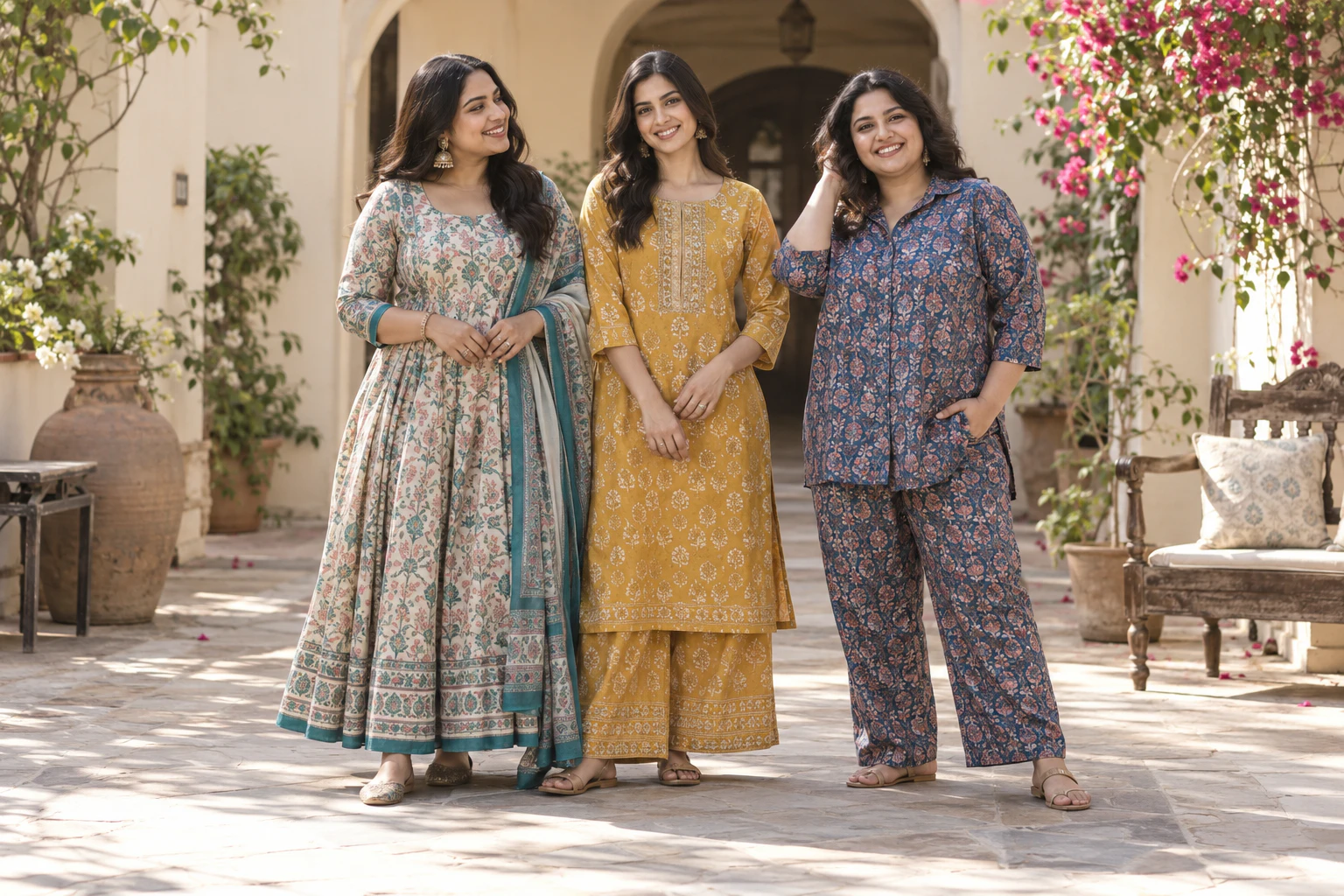
A kurta set can mean many different shapes: a flowing Anarkali, a neat straight kurta with pants, a breezy kurta with palazzo, a modern co-ord, or a complete three-piece set with a dupatta. Each one feels different to wear and suits a different occasion. This guide explains the main types of kurta sets for women, how each one fits, and which to choose for office, college, festivals and weddings.
Types of kurta sets at a glance
| Straight kurta set | Clean, neat line; best for office and daily wear |
|---|---|
| A-line kurta set | Fitted at the shoulder, gently flared; flattering and easy |
| Kurta with palazzo | Relaxed and airy; ideal for summer, travel and long days |
| Anarkali set | Fitted bodice with a full flare; the classic festive choice |
| Co-ord set | Matching top and bottom; modern, light, no dupatta needed |
| Three-piece set with dupatta | Kurta, bottom and dupatta; the most complete traditional look |
1. Straight kurta set
A straight kurta falls in a clean line from the shoulder to the hem. With straight pants or cigarette pants it looks crisp and professional; with a dupatta it becomes ready for a puja or a family lunch.
- Feels like: neat and easy, nothing to manage.
- Best for: office, college, travel and small family functions.
- Fit tip: check the bust and hip on the size chart. A straight kurta should skim the hip without pulling across it.
2. A-line kurta set
An A-line kurta is fitted at the shoulder and bust and widens gently towards the hem, like the letter A. It is one of the most flattering and forgiving shapes for every body type.
- Feels like: comfortable, with a little movement.
- Best for: everyday wear, day outings, small pujas and college.
- Fit tip: the bust measurement matters most; the flare takes care of the hip.
3. Kurta with palazzo
A palazzo is a wide, flowing pant. Paired with a straight or A-line kurta it creates a relaxed, airy look that is perfect for Indian summers.
- Feels like: breezy and free; great in heat.
- Best for: summer days, travel, long workdays and casual get-togethers.
- Style tip: a slightly shorter kurta, at the knee or just above, balances the volume of the palazzo.
4. Anarkali set
An Anarkali is fitted at the top and opens into a full, flared skirt from below the bust or waist. It is the classic festive silhouette and looks beautiful when you walk, sit for a puja or twirl in a photograph.
- Feels like: graceful and festive; it carries more fabric.
- Best for: Diwali, Karwa Chauth, weddings, sangeet, mehendi and evening functions.
- Fit tip: take your bust measurement carefully; that is where an Anarkali must fit well.
5. Co-ord set
A co-ord set is a matching top and bottom in the same print or fabric. It looks put together without a dupatta, which makes it the most modern and practical option.
- Feels like: light and contemporary.
- Best for: brunches, travel, casual Fridays, college and day events.
- Style tip: wear the pieces separately too: the top with jeans, the bottom with a plain kurti.
6. Three-piece kurta set with dupatta
A three-piece set includes the kurta, a matching bottom and a dupatta. It is the most complete traditional look, and the dupatta adds colour and grace in photographs.
- Feels like: traditional and complete.
- Best for: festivals, family visits, pujas, haldi and daytime wedding functions.
- Style tip: a printed or chanderi dupatta lifts a simple cotton kurta into a festive outfit.
Which kurta set for which occasion?
| Office and daily wear | Straight kurta set, or a co-ord set |
|---|---|
| College and day out | Co-ord set, or an A-line kurta with palazzo |
| Summer and travel | Cotton kurta with palazzo, or a cotton co-ord |
| Puja and family visits | Three-piece kurta set with dupatta |
| Festivals and evening functions | Anarkali set, or a kurta set with a chanderi dupatta |
| Haldi and mehendi | Yellow or green printed kurta set, or a light Anarkali |
Which shape suits your body type?
There is no strict rule; wear what makes you feel good. A few general guides help:
- If you want a longer, leaner look: straight kurtas and calf-length styles with straight pants.
- If you want more room around the hip: A-line kurtas and Anarkalis flare away from the hip.
- If you are petite: knee-length kurtas, co-ord sets and solid or small prints keep proportions balanced.
- If you are tall: longer Anarkalis and kurtas with palazzo look graceful.
Before you order a kurta set online
- 1Measure yourself.Note your bust, waist and hip, and compare them with our size guide.
- 2Read the product details.Check the fabric, the kurta length and the fit notes on the product page.
- 3Check what is in the set.Kurta only, two pieces, or three pieces with a dupatta.
- 4Think about the occasion.Daily wear needs easy care; festive wear can be richer.
Explore our kurta co-ord sets, co-ord sets, kurtis and dresses. Not sure which shape to pick? Ask Sakhi, our AI stylist, on the shop page and tell her your occasion.
What is the difference between an Anarkali and a straight kurta?
A straight kurta falls in a clean line from the shoulder to the hem. An Anarkali is fitted at the top and opens into a full flare from below the bust or waist, so it looks more festive.
Which kurta set is best for office wear?
A straight kurta with straight pants, or a co-ord set, looks neat and is easy to wear all day. Breathable cotton is a good choice for daily office wear.
What should I wear to a wedding function: Anarkali or kurta set?
An Anarkali set is the classic choice for evening functions, sangeet and mehendi. A three-piece kurta set with a printed or chanderi dupatta works well for daytime functions, pujas and haldi.
Is a co-ord set the same as a kurta set?
Not quite. A co-ord set is a matching top and bottom in the same print or fabric and usually has no dupatta. A kurta set has a kurta with a bottom, and often a dupatta.
How do I choose the right size for a kurta set online?
Measure your bust, waist and hip and compare them with the size chart. For Anarkalis and A-line kurtas the bust matters most; for straight kurtas check the hip too.
Last updated 11 October 2026